
Short answer: the best way to prepare for 2026 networking interview questions is to combine fundamentals with modern context. You still need OSI, TCP, UDP, DNS, subnetting, switching, routing, and troubleshooting. But strong candidates now also explain IPv6, cloud networking, zero-trust security, automation, observability, and protocols such as QUIC without losing sight of practical operations.
This updated guide replaces the 2025 framing with what hiring teams are more likely to test in 2026. Network administrators, network engineers, cloud engineers, DevOps engineers, and cybersecurity candidates are expected to show not only definitions, but judgment: when to use a protocol, how to troubleshoot a failure, how to secure a design, and how to explain technical trade-offs clearly. If you are applying in Germany, pair this technical preparation with iKnowly’s guide to German interview questions and answers, because structured, evidence-based communication often matters as much as the correct technical answer.
For each topic below, prepare three things: a two-minute explanation, one real troubleshooting example, and one simple diagram you could sketch on a whiteboard. That combination shows both conceptual knowledge and field readiness.
What changed for networking interviews in 2026?
The basics have not disappeared, but the environment around them has changed. Most organisations now operate across office networks, cloud platforms, remote users, SaaS applications, identity providers, VPN or ZTNA tools, and managed security services. Interviewers therefore listen for systems thinking, user-impact awareness, and security judgment.
AI has also entered network operations through alert grouping, anomaly detection, log summarisation, and configuration assistance. That does not remove the need for fundamentals. In fact, it makes them more important. If a tool suggests a root cause, you still need to validate it with packet captures, routing tables, logs, DNS lookups, and user-impact evidence.
Key Insight: In 2026, the best networking candidates do not only explain how protocols work. They explain how to use fundamentals to diagnose real problems, secure systems, and communicate impact clearly.
1. Explain the OSI model and how you use it for troubleshooting
The OSI model remains one of the most common networking interview questions because it reveals whether you can reason through a network problem layer by layer. Do not simply recite the seven layers. Explain how the model helps you isolate failure.
A strong answer starts at Layer 1 and moves upward: check link lights, cabling, wireless signal, VLAN assignment, IP configuration, routing, firewall policy, transport ports, DNS, TLS, and application behaviour. Then give a practical example: “If a user cannot reach an internal web app, I first verify physical or wireless connectivity, then IP address and gateway, then DNS resolution, then TCP connection to the service port, then application logs.”
How to Structure Your Answer
- Start with the purpose: Explain that the OSI model is a troubleshooting map that helps isolate where a failure is happening.
- Move layer by layer: Mention physical connectivity, switching, IP configuration, routing, transport ports, DNS, TLS, and application behaviour.
- Give a real example: Use a scenario such as a user being unable to access an internal web application.
- Show maturity: Clarify that the OSI model is useful, but not a perfect description of every modern protocol.
Key Insight: Avoid only listing the seven OSI layers. Interviewers want to see whether you can use the model to diagnose a real issue under pressure.
2. What is the difference between TCP, UDP, and QUIC?
TCP and UDP are still essential, but in 2026 you should also understand why QUIC matters. TCP is connection-oriented and reliable. It handles ordering, retransmission, congestion control, and flow control. UDP is connectionless and lightweight, making it useful for DNS, streaming, voice, gaming, and protocols that build reliability elsewhere.
QUIC is important because it runs over UDP while adding secure, multiplexed transport features used by modern web traffic. The official RFC 9000 QUIC specification is a strong source if you want to understand the protocol more deeply. In an interview, you do not need to quote the RFC, but you should be able to explain why QUIC can reduce connection setup latency and avoid some head-of-line blocking issues seen with older stacks.
How to Structure Your Answer
- Compare reliability: TCP provides built-in reliability and ordering, while UDP is lightweight and does not guarantee delivery.
- Compare use cases: Use TCP for SSH or file transfer, UDP for DNS or voice, and QUIC for modern HTTP/3-style web performance.
- Explain trade-offs: Mention latency, overhead, connection setup, congestion control, and reliability.
- Add the 2026 angle: Explain that QUIC matters because modern web traffic increasingly uses UDP-based secure transport.
Key Insight: A strong answer does not treat TCP and UDP as “good versus bad.” It explains when each protocol is useful and what trade-offs come with that choice.
3. How does DNS resolution work?
DNS is one of the highest-value topics because it appears in almost every outage. A good answer explains recursive resolvers, root servers, TLD servers, authoritative name servers, record types, TTL, caching, and negative caching. You should also explain practical tools such as dig, nslookup, and resolver configuration checks.
The Cloudflare DNS guide is a clear refresher on the lookup chain. In an interview, connect theory to troubleshooting. For example: “If a service works by IP but not by hostname, I test DNS resolution, compare internal and external answers, check CNAME chains, verify TTL, and confirm whether split-horizon DNS is involved.”
A 2026-ready answer should also mention DNS security concepts such as DNSSEC awareness, secure resolvers, and the operational risk of stale records during migrations.
How to Structure Your Answer
- Explain the lookup chain: Cover recursive resolvers, root servers, TLD servers, and authoritative name servers.
- Mention records: Include A, AAAA, CNAME, MX, TXT, and TTL where relevant.
- Connect to troubleshooting: Explain what you check when a hostname fails but the IP address works.
- Add security context: Mention DNSSEC awareness, secure resolvers, stale records, and split-horizon DNS.
Key Insight: DNS interview answers become stronger when you move from “DNS converts names to IP addresses” to “DNS failures can break login, routing, CDN behaviour, email, and migrations.”
4. What is subnetting, and how do you calculate host ranges?
Subnetting tests practical network design. You should be comfortable explaining CIDR notation, subnet masks, network addresses, broadcast addresses, usable host ranges, and why segmentation matters for security and performance. Do not hide behind calculators. Interviewers may ask you to work through a simple example.
For example, a /24 network has 256 total addresses and 254 usable host addresses in traditional IPv4 subnetting. A /26 creates four subnets with 64 addresses each, typically 62 usable hosts per subnet.
In 2026, also be ready for IPv6. You do not need to memorise every IPv6 detail, but you should understand that IPv6 uses 128-bit addresses and different design conventions. The official RFC 8200 IPv6 specification is the formal reference for the protocol.
How to Structure Your Answer
- Define subnetting: Explain that it divides a larger network into smaller logical networks.
- Show the calculation: Use a simple example such as
/24and/26. - Explain why it matters: Mention segmentation, routing control, broadcast reduction, and security policy.
- Add IPv6 awareness: Explain that IPv6 changes addressing scale and design conventions.
Key Insight: Interviewers are not only testing math. They want to know whether you understand why subnetting supports scalable, secure, and manageable network design.
5. What is the difference between a switch and a router?
This question checks whether you understand Layer 2 and Layer 3 responsibilities. A switch forwards frames inside a local network using MAC addresses. A router forwards packets between networks using IP addresses and routing tables. That simple distinction is the starting point, not the whole answer.
To stand out, explain VLANs, trunk ports, default gateways, ARP, inter-VLAN routing, and why enterprise switches often include Layer 3 features. Then give a practical example: a laptop can reach devices in the same VLAN through switching, but it needs a gateway to reach another subnet or the internet.
If the role involves cloud, connect this to virtual networks, route tables, security groups, and load balancers. Cloud networking uses different interfaces, but the logic of segmentation, routing, and policy still applies.
How to Structure Your Answer
- Start simple: Switches forward frames with MAC addresses; routers forward packets with IP addresses.
- Add enterprise detail: Mention VLANs, trunks, ARP, gateways, and inter-VLAN routing.
- Give a practical example: Explain same-VLAN traffic versus traffic that must leave the subnet.
- Connect to cloud: Relate the concept to virtual networks, route tables, security groups, and load balancers.
Key Insight: A strong answer shows that you understand both the textbook distinction and how switching and routing appear in real enterprise and cloud environments.
6. How do routing protocols like OSPF and BGP differ?
Routing questions test whether you can think beyond a single device. OSPF is commonly used inside an organisation as an interior gateway protocol. It builds a view of network topology and calculates paths based on cost. BGP is used between autonomous systems and is central to internet routing. It is policy-driven and designed for scale.
A strong answer compares scope, convergence, metrics, administrative control, and use cases. OSPF is usually about internal path selection. BGP is about reachability, policy, peering, and route control between networks or providers. For cloud and hybrid environments, BGP often appears in VPN, direct connect, or private connectivity designs.
Interviewers may ask how you would troubleshoot routing. Mention checking route tables, next hops, neighbour relationships, advertised prefixes, route filters, metrics, and whether asymmetric routing or firewall policy is affecting the path.
How to Structure Your Answer
- Compare scope: OSPF is usually internal; BGP is used between autonomous systems and providers.
- Compare decision logic: OSPF uses cost; BGP is policy-driven and supports large-scale route control.
- Explain troubleshooting: Mention neighbour status, advertised prefixes, next hops, route filters, and metrics.
- Add hybrid context: Explain where BGP appears in VPN, cloud direct connect, or private connectivity designs.
Key Insight: OSPF is mainly about efficient internal path selection. BGP is mainly about policy, reachability, and control between networks.
7. How would you troubleshoot a slow application?
This is one of the best practical networking interview questions because it forces you to connect user experience with technical evidence. Do not jump straight to “the network is slow.” A strong candidate separates client, network, DNS, TLS, application, database, and server-side causes.
Start by defining the symptom: who is affected, where they are located, when it started, and whether the issue is latency, packet loss, throughput, login delay, or page rendering. Then collect evidence: ping, traceroute, DNS timing, packet capture, browser waterfall, application logs, interface errors, CPU, memory, and recent changes. The Wireshark User’s Guide is useful if you need to refresh packet-capture workflows.
The best answer ends with communication: “I would update stakeholders with what is known, what is ruled out, what is being tested next, and when they can expect the next update.” This is where technical skill overlaps with broader interview skills covered in program manager interview questions.
How to Structure Your Answer
- Define the symptom: Ask who is affected, when it started, where it happens, and what “slow” means.
- Separate causes: Consider client, network, DNS, TLS, application, database, and server-side issues.
- Collect evidence: Use ping, traceroute, DNS timing, packet capture, browser waterfall, logs, and system metrics.
- Communicate progress: Explain what is known, what is ruled out, and what is being tested next.
Key Insight: The phrase “the network is slow” is not a diagnosis. Strong candidates define the symptom, gather evidence, and isolate the failing layer before making conclusions.
8. How do you secure a modern network?
Security is now part of nearly every networking role. A 2026 answer should include segmentation, least privilege, firewall policy, secure remote access, MFA, logging, patching, vulnerability management, DNS filtering, endpoint visibility, and incident response. If the company uses cloud, add identity-aware access, security groups, private endpoints, and centralised logging.
The NIST Cybersecurity Framework is a credible external reference because it organises security work around identifying, protecting, detecting, responding, and recovering. In an interview, connect this to everyday network operations: know assets, reduce attack surface, monitor anomalies, and plan recovery before an incident happens.
How to Structure Your Answer
- Start with fundamentals: Mention segmentation, least privilege, secure remote access, MFA, and firewall policy.
- Include visibility: Discuss logging, monitoring, DNS filtering, endpoint visibility, and anomaly detection.
- Cover response: Explain patching, vulnerability management, incident response, and recovery planning.
- Add cloud security: Mention identity-aware access, security groups, private endpoints, and centralised logs.
Key Insight: Modern network security is not only about blocking traffic. It is about knowing assets, reducing attack surface, monitoring behaviour, and preparing recovery before an incident occurs.
9. What networking skills matter for cloud and hybrid environments?
Cloud networking interviews often test whether you can translate fundamentals into managed platforms. Be ready to discuss virtual networks, subnets, route tables, NAT gateways, private connectivity, DNS zones, load balancers, firewall rules, identity-based access, and observability. The names differ between AWS, Azure, and Google Cloud, but the principles are familiar.
For Germany-based roles, also prepare to discuss compliance, data residency, documentation, and change control. iKnowly’s guide on how to find work in Germany can help you position technical skills locally, while the guide on how to write a German CV can help you express projects with measurable outcomes.
How to Structure Your Answer
- Translate the basics: Explain how subnets, routing, DNS, and firewalls appear in cloud platforms.
- Mention managed components: Include NAT gateways, load balancers, DNS zones, VPNs, and private connectivity.
- Discuss observability: Explain logs, metrics, flow logs, traces, alerts, and user-impact monitoring.
- Localise for Germany: Mention documentation, compliance, data residency, and structured change control where relevant.
Key Insight: Cloud networking is not a completely separate discipline. It is traditional networking logic expressed through managed services, identity controls, and platform-specific interfaces.
10. How do you keep your networking knowledge current?
This question matters more in 2026 because the field changes quickly. A good answer mentions hands-on labs, vendor documentation, packet captures, home labs, cloud sandboxes, certifications, RFC reading, post-incident reviews, and learning from senior engineers. Avoid saying only that you “read blogs.” Show a real learning system.
For example: “Every month I rebuild one lab scenario, such as BGP failover, DNS troubleshooting, or firewall policy testing. I document what failed, what I learned, and how I would explain it in an interview.” If you want expert feedback on your examples, iKnowly’s career development mentors can help you turn technical experience into clear interview stories.
How to Structure Your Answer
- Show a system: Explain how you learn every month, not only when you need a job.
- Use practical examples: Mention labs, packet captures, cloud sandboxes, and post-incident reviews.
- Use credible sources: Include vendor docs, RFCs, certification material, and senior engineer feedback.
- Connect learning to interviews: Explain how you turn technical practice into clear stories.
Key Insight: Interviewers do not want to hear only that you “keep learning.” They want to know what your learning routine looks like and how it improves your practical work.
Networking Interview Questions Comparison
| Question Topic | What It Tests | Best Evidence to Prepare | 2026 Angle |
|---|---|---|---|
| OSI model | Layered reasoning | Layer-by-layer troubleshooting story | Use fundamentals to validate AI-assisted diagnosis |
| TCP, UDP, QUIC | Transport trade-offs | Latency, reliability, and use-case examples | Modern web performance and UDP-based protocols |
| DNS | Core internet services | Resolver chain, records, TTL, troubleshooting tools | DNS security, split-horizon DNS, and migration risk |
| Subnetting | IP design skill | CIDR calculations and segmentation rationale | IPv6 awareness and cloud subnet planning |
| Switching and routing | Layer 2 and Layer 3 clarity | VLAN, gateway, ARP, and route-table examples | Virtual networks and hybrid routes |
| Troubleshooting | Practical judgment | Evidence collection and communication plan | Observability, packet capture, and user impact |
| Security | Risk thinking | Segmentation, least privilege, logs, and recovery plan | Zero trust, cloud security, and compliance |
How to prepare your answers before the interview
Build a small answer bank. For each topic, write one definition, one command or tool you would use, one real-world failure scenario, and one business impact. This makes your answers specific without sounding memorised. For example, DNS is not just “domain to IP.” It is also user login failures, expired records, resolver misconfiguration, CDN routing, and migration downtime.
Practise explaining technical topics to both technical and non-technical audiences. A senior engineer may ask for packet-level detail. A hiring manager may want to know how you reduce downtime. A recruiter may simply need to hear that you can communicate clearly. The best networking professionals can move between those levels.
From Preparation to Performance
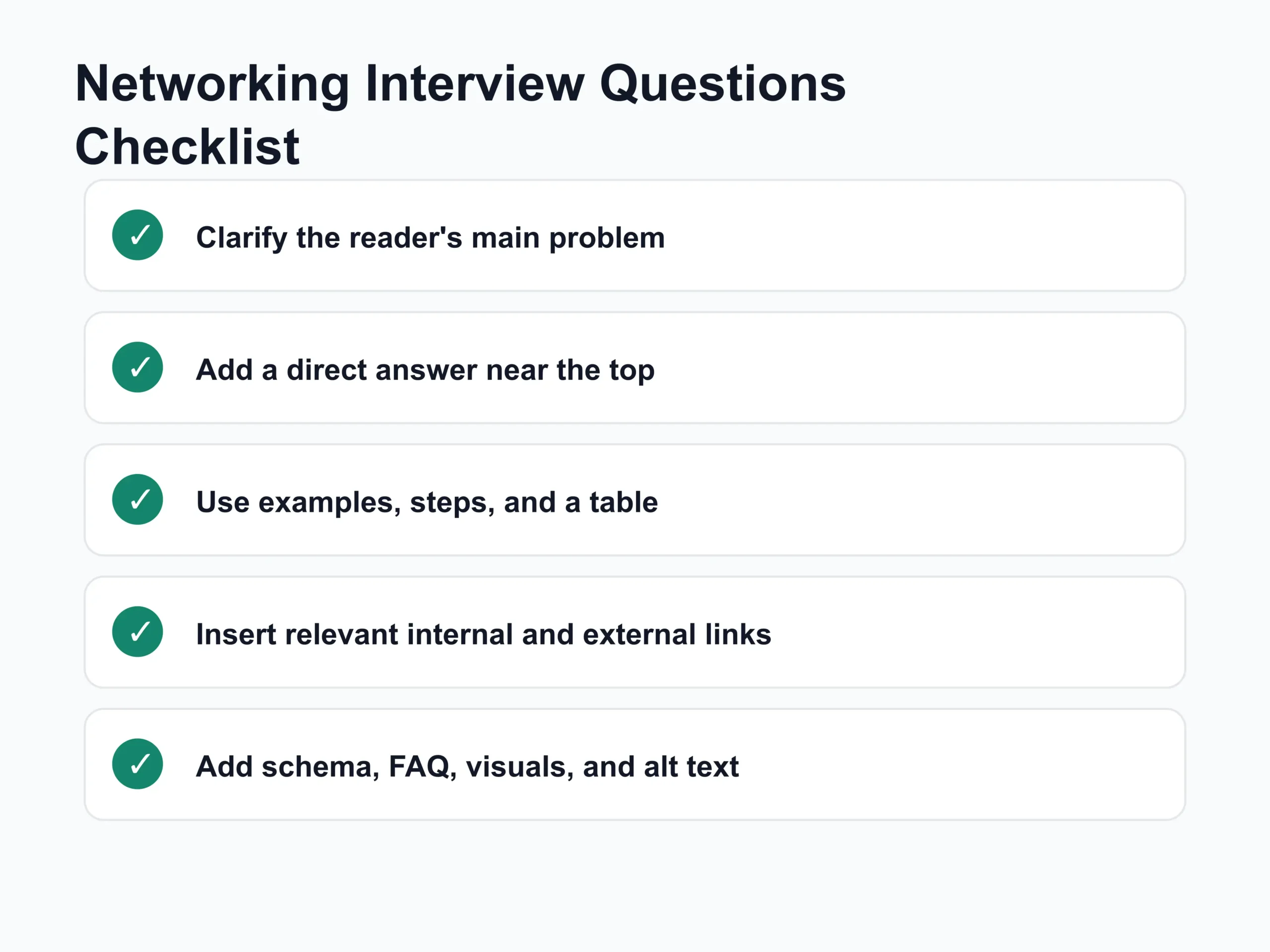
- Build one story per topic: Prepare at least one troubleshooting or design example for OSI, DNS, routing, cloud networking, and security.
- Prepare one simple diagram: Practise sketching a subnet, DNS lookup chain, routing path, or client-server flow.
- Use commands naturally: Be ready to mention tools such as
ping,traceroute,dig,nslookup, packet capture, route tables, and logs. - Connect to business impact: Explain how the issue affected users, downtime, security, performance, or cost.
Key Insight: The strongest candidates do not only know the correct answer. They can explain how they would investigate, communicate, and reduce risk in a real working environment.
Conclusion: prove fundamentals plus modern judgment
The strongest answers to networking interview questions in 2026 show both depth and adaptability. You need to understand OSI, TCP, UDP, DNS, subnetting, switching, routing, and troubleshooting. But you also need to connect those fundamentals to cloud, security, automation, observability, and real user impact.
Prepare examples, not just definitions. Sketch diagrams. Practise explaining trade-offs. Show how you diagnose before you decide. That combination will help you stand out in networking, cloud, and cybersecurity interviews.
Frequently Asked Questions
What are the most common networking interview questions in 2026?
The most common topics are the OSI model, TCP versus UDP, DNS, DHCP, subnetting, switching, routing, troubleshooting, network security, and cloud networking.
Do I need to know IPv6 for networking interviews?
Yes. You do not need to memorise every IPv6 detail, but you should understand 128-bit addressing, why IPv6 exists, and how IPv6 changes network design and troubleshooting.
How should I answer troubleshooting questions?
Start with scope and symptoms, collect evidence, test layer by layer, rule out causes, communicate progress, and explain the final root cause clearly.
Should I mention cloud networking in a traditional network engineer interview?
Yes, when relevant. Many traditional networking roles now touch cloud, VPNs, identity-aware access, DNS zones, load balancers, and hybrid routing.
Ready to turn your technical knowledge into stronger interview answers? Practise your networking stories and get personalised, real-time feedback from experienced professionals on iknowly. Book a 1:1 video consultation to refine your examples, improve your structure, and walk into your next interview with more confidence.
Leave a Reply